
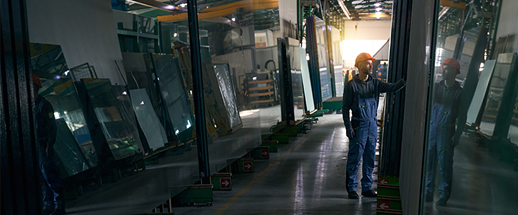
Glass transport racks are specialized steel racks engineered to safely move and store large, flat sheets of glass. They hold glass upright at a slight lean so that gravity seats each sheet securely against the frame, protecting the load during internal plant movement, warehouse storage, and over-the-road delivery. NSMC has supplied glass transport racks to many of the country's leading float and flat glass manufacturers for over 30 years, building each rack with full seam welds for the strength and safety that heavy glass demands.
Single-sided loading:
An L-Buck glass rack is an L-shaped steel rack that loads glass on one side against a single vertical back support. The compact, one-sided footprint fits tight aisles, walls, and corners, and empty L-Bucks nest together like shopping carts to dramatically lower return-freight cost. L-Bucks are the favorite for manual single-sheet picking and for returnable shipping programs.
Double-sided loading:
An A-Frame glass rack uses two upright beams welded to a top crossbar to form a triangular "A" that loads glass on both sides. The double-sided design stores or transports roughly twice the glass of an L-Buck in the same floor footprint, and the open structure lets operators see and select sheets from either side. A-Frames suit high-volume staging and crane or sling handling of large sheets.
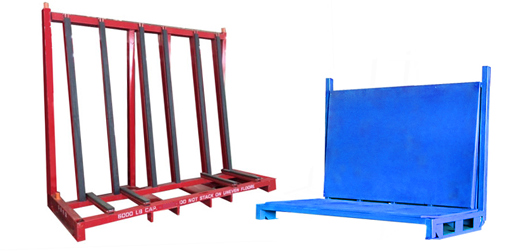
L-Buck Glass Racks
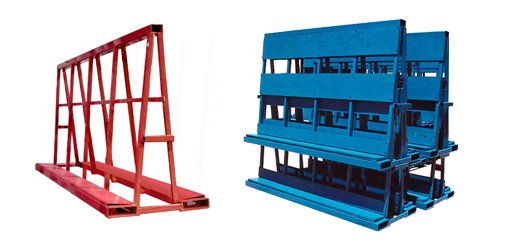
A-Frame Glass Racks
NSMC makes sure your glass never touches the steel frame in order to protect the glass. We offer custom dunnage and wooden panels using countersunk fasteners to protect your glass from chips, scratches or breakage.
| Attribute | L-Buck Rack | A-Frame Rack |
|---|---|---|
| Loading sides | One side (single-sided) | Two sides (double-sided) |
| Footprint vs. capacity | Compact; fits walls & tight aisles | Stores ~2× the glass per footprint |
| Glass lean angle | 3–5° against vertical back | Sheets lean to each side of the "A" |
| Typical capacity* | 2,000–8,000 lb (1–4 tons) | 2,000–8,000 lb (1–4 tons) |
| Nesting for return freight | Yes — nests like carts | Limited; bulkier to return empty |
| Best for | Tight space, single-sheet picking, returnable programs | High-volume staging, two-sided access, crane/sling handling |
| Typical movement | Forklift pockets, casters | Forklift, overhead crane, lifting sling, AGV systems |
*Capacities are custom-engineered per rack. NSMC sizes each rack so its rated capacity safely exceeds the heaviest glass pack it will carry.
Every NSMC glass transport rack is custom fabricated to your glass size, load, and workflow.
Typical glass transport rack specifications
| Specification | Typical Range / Option |
|---|---|
| Load capacity | (5 tons), engineered to application |
| Frame construction | Square / rectangular structural steel tubing, full seam welded |
| Glass lean angle | 3–5° against the back support |
| Dunnage / padding | Soft rubber, HDPE, UHMW, urethane |
| Mobility | Stationary, forklift-accessible (fork pockets), or heavy-duty swivel casters |
| Glass types handled | Float, flat, tempered, laminated, Low-E, insulated glass units (IGU); jumbo sizes |
| Finish | Paint or powder coat in any color; stenciling of company name, dept., or ID |
For returnable shipping programs, the rack you choose directly affects freight cost. Empty L-Buck racks nest into one another like shopping carts, so many more empties fit on a return truck or in a container than bulky, non-nesting A-Frames. For distributors shipping tempered glass or IGUs out and returning empties, nesting L-Bucks can consolidate several delivery runs into a single return load — cutting fuel, driver hours, and freight spend. NSMC has built returnable steel racks since 1994 and can engineer your glass rack program around return logistics from the start.
The surfaces that touch the glass determine whether your sheets arrive intact. NSMC offers padding in soft rubber, HDPE, UHMW, and urethane. .
A large glass manufacturer approached NSMC after a glass transport rack failed at its weld seams, causing a serious accident. Investigation showed the failed racks had been stitch welded to reduce cost, while NSMC's racks for the same customer used a complete seam-welding process. The lesson defines how we build: full seam welds, never stitch welds, so the entire frame distributes load and resists the torsion of daily forklift handling.
Glass Rack Safety Case StudyWhat is a glass transport rack?
A glass transport rack is a specialized steel rack engineered to hold, move, and store large flat sheets of glass upright and securely. The two common configurations are the L-Buck (single-sided) and the A-Frame (double-sided). Both are used throughout glass plants, fabrication shops, and construction sites to reduce breakage and streamline handling.
What is the difference between an L-Buck and an A-Frame glass rack?
An L-Buck loads glass on one side against a single vertical back, giving a compact footprint and the ability to nest for cheaper return freight. An A-Frame loads both sides of a triangular frame, roughly doubling capacity in the same footprint and giving two-sided visibility and access. L-Bucks favor space efficiency and return logistics; A-Frames favor storage density and access.
How much weight can a glass transport rack hold?
Custom industrial glass racks are commonly engineered for 2,000 to 8,000 pounds (1 to 4 tons) per rack, depending on steel tubing size, base design, and weld quality. NSMC sizes each rack so its rated capacity safely exceeds the heaviest glass pack it will carry.
At what angle should glass be stored on a rack?
Flat glass is stored at a slight 3 to 5 degree lean against the rack's vertical back support, so gravity seats the glass against the frame and prevents tipping during handling or transport.
Why do full seam welds matter?
Full seam welds fuse the frame into one rigid unit that distributes load and resists twisting under forklift handling. Stitch or tack welds leave stress points that can crack after repeated heavy loading. NSMC builds every glass rack with full seam welds.